 Day Trips from Kyoto
How to Plan a Day Trip from Kyoto
This page covers how to plan a day trip from Kyoto: which station to use for which destination, which ticket or pass makes sense, how seasons and temple hours change the day, what to pack, and how tour meeting points work at Kyoto Station. Most day trips start at Kyoto Station or at Demachiyanagi, Kyoto-kawaramachi, Sanjo or Gion-Shijo. The Nara Line Miyakoji rapid reaches JR Nara in 45 minutes for 720 yen one way, which shows how short the journeys are. If you want the per-destination details, the day trips from Kyoto map and the free-by-train guide cover each place in depth. The bookable tours are compared on day trips from Kyoto.
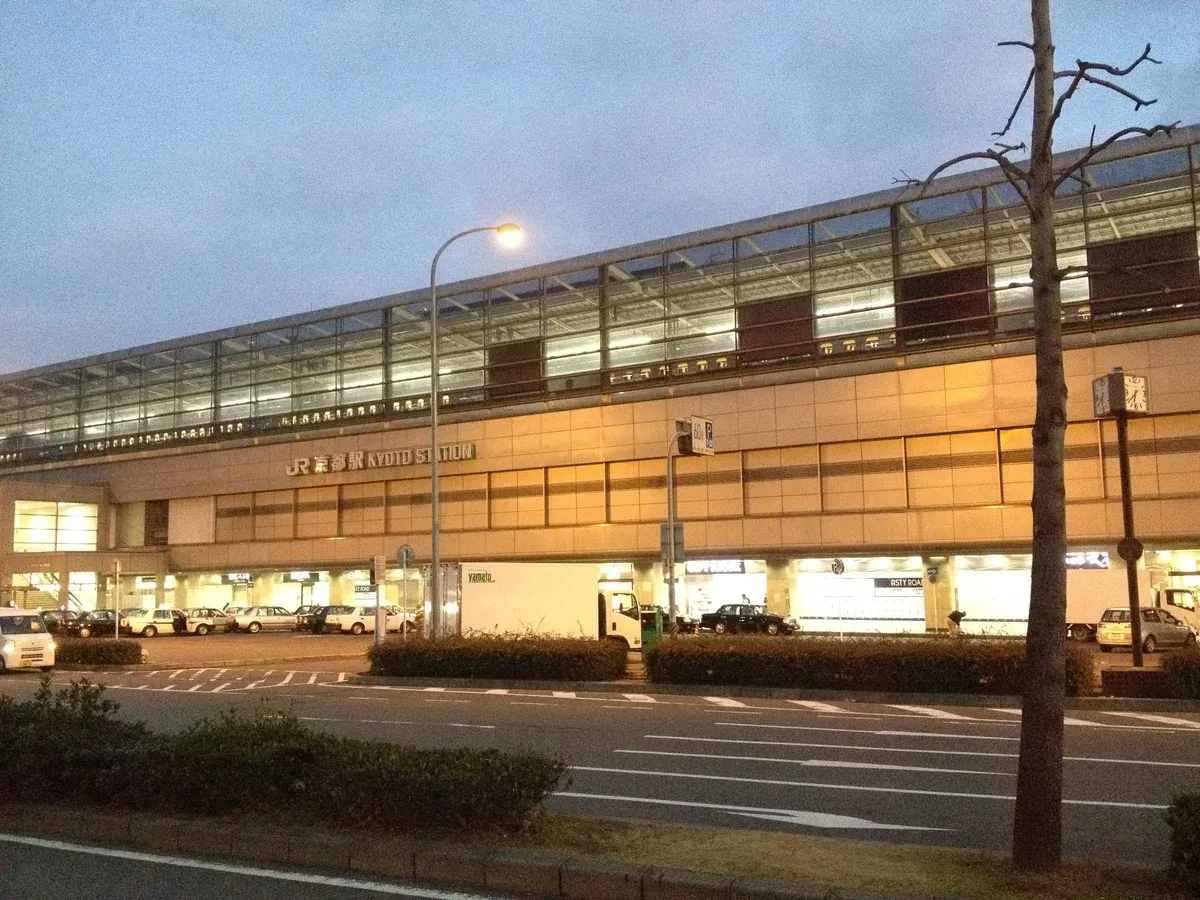
The Hachijo exit side of Kyoto Station at dusk with the shinkansen entrance. Photo: Masaru Kamikura, CC BY 2.0, via Wikimedia Commons
Quick answer Plan the trip
To plan a day trip from Kyoto, match the destination to a station, pick a ticket or pass, check the season and the temple hours, and arrive at the meeting point 10 to 15 minutes early. The JR Nara Line rapid takes 45 minutes to Nara for 720 yen, and the Special Rapid reaches Himeji in about 90 minutes for 2,210 yen.
Key takeaways
- Match the station to the trip with the station table: JR and Kintetsu at Kyoto Station, Eizan at Demachiyanagi, Hankyu at Kyoto-kawaramachi, Keihan at Sanjo and Gion-Shijo.
- Compare passes in the tickets and passes section, including the Japan Rail Pass and where it stops working.
- Check seasons and hours before fixing a date, because rainy season, typhoon months and holidays change everything.
- If you would rather book, see how tour meeting points work, or browse all day trips from Kyoto on the homepage.
Which Kyoto Station for Which Day Trip
Kyoto has more than one departure point, and picking the wrong one costs time. Kyoto Station alone holds JR, Kintetsu and the Shinkansen, while three other stations serve the Eizan, Hankyu and Keihan lines.
Kyoto Station and Its Two Sides
Kyoto Station has a north Central Exit near Kyoto Tower, where city buses and taxis board, and a south Hachijo Exit. The Shinkansen gates sit on the Hachijo side, and the Kintetsu boarding area is just outside the Shinkansen Central Gate. The Hachijo Exit serves expressway buses, airport buses and hotel shuttles. If a tour says Hachijo, go to the south side. If it says Central Ticket Gate, go north, where Kyoto Tower stands. The Shinkansen Central Gate is a different place on the Hachijo side. The JR Nara Line Miyakoji rapid to JR Nara leaves Kyoto Station every 30 minutes and takes 45 minutes for 720 yen one way, and the JR Sagano Line reaches Saga-Arashiyama in 15 minutes for 240 yen.
The table below lists each departure station, the line that runs from it, and the day trips it serves.
| Station | Line | Day trips |
|---|---|---|
| Kyoto Station (JR) | JR Nara, Sagano and Tokaido lines, Shinkansen | Nara (JR Nara, 45 min, 720 yen), Uji (20-30 min, 240 yen), Osaka (Special Rapid, about 29 min, 580 yen), Kobe (Special Rapid, about 50 min, roughly 1,000 to 1,100 yen), Himeji (about 90 min, 2,210 yen), Hikone (50 min, 1,170 yen), Hiroshima (Nozomi, about 1 hour 36 min, 10,770 yen non-reserved), Amanohashidate (Hashidate limited express, 2 hours, 4,800-5,400 yen) |
| Kyoto Station (Kintetsu, near the Shinkansen Central Gate) | Kintetsu Kyoto Line | Kintetsu Nara (limited express 35 min, 1,280 yen, or express 45 min, 760 yen), Ise (direct limited express, about 2 hours) |
| Kyoto Station Hachijo Exit | Highway and airport buses | Arima Onsen (about 70 min, 1,850 yen), Amanohashidate (Tankai bus, about 2 hours, 3,200-3,400 yen), Ohara (Kyoto Bus 17, 60 min, 630 yen) |
| Demachiyanagi | Eizan Railway | Kurama (about 30 min, 470 yen) and Kibune (Kibuneguchi about 28 min) |
| Kyoto-kawaramachi | Hankyu | Osaka (Osaka-umeda, 43-48 min, 410 yen), Kobe (Kobe-sannomiya, one change at Juso, about 60 min, around 630 to 640 yen) |
| Sanjo and Gion-Shijo | Keihan | Uji (via Chushojima, about 30 min, 400 yen), Osaka (Yodoyabashi to Sanjo, about 50 min, 490 yen), Fushimi Inari (Fushimi Inari Station) |
Start From Where You Sleep
Kyoto Station sits south of the centre at Hachijo-dori, so travellers staying near Kawaramachi or Karasuma may reach their destination faster from Gion-Shijo or Kyoto-kawaramachi. The Keihan route to Uji, for example, suits visitors starting near the Kamogawa River rather than Kyoto Station. For Kurama and Kibune, Demachiyanagi is the only sensible start, with Eizan trains every 15 to 20 minutes.
For per-destination route choices, the Kyoto to Nara train and Kyoto to Hiroshima guides go deeper than this page, and the free day trips guide covers free day trips from Kyoto.
Sources: Kyoto City Travel
Tickets, IC Cards and Passes
You do not need a pass for every trip. An IC card plus occasional paper tickets covers most single days, and the case for a pass depends on how many paid train days you plan.
IC Cards and Supplements
ICOCA is sold at Kyoto Station, and a new card needs a 500 yen refundable deposit with a typical 1,500 yen initial charge. An ICOCA stays valid for 10 years, and refunding one incurs a 220 yen handling fee that can only be done in JR West territory. Two things an IC card does not do: it does not buy a limited express seat, and it does not replace a pass on lines that require reservations.
Kintetsu limited expresses to Nara and Ise have reserved seats only and need a separate express ticket on top of the fare. Seat reservations are also mandatory on the Hashidate and Kinosaki limited expresses toward Amanohashidate and Kinosaki.
The Regional Passes
The WEST QR Kansai Area Pass costs 2,700 yen for 1 day, 4,700 yen for 2, 5,500 yen for 3 and 6,700 yen for 4 days. It covers non-reserved seats on ordinary trains and the HARUKA across Kyoto, Nara, Kobe and Himeji, but not the shinkansen, and it needs a smartphone to show a QR code at the gates. The Kintetsu Rail Pass costs 1,900 yen for 1 day, 3,700 yen for 2, 4,900 yen for 5 days and 6,700 yen for the 5-day Plus.
The 1-day and 2-day versions cover Osaka, Nara and Kyoto, and holders pay limited express supplements separately. The JR Kansai WIDE Area Pass costs 12,000 yen for 5 consecutive days and covers Amanohashidate and Kinosaki Onsen excursions plus the Sanyo Shinkansen from Shin-Osaka to Okayama. The Japan Rail Pass does not cover the Kyoto Tango Railway section.
The Japan Rail Pass and Its Limits
The 7-day Ordinary Japan Rail Pass rises from 50,000 yen to 53,000 yen at overseas agents from 1 October, while buyers on the official website keep the lower price. It covers the JR Nara Line to Nara and Uji, the Special Rapid to Osaka, Kobe and Himeji, and the JR Sanyo Line from Hiroshima Station to Miyajimaguchi. It does not cover Kintetsu trains, so a Kintetsu Nara day is self-funded.
It does not cover the Kyoto Tango Railway section to Amanohashidate, though the Kansai WIDE Area Pass does. It is not valid on the Eizan Railway to Kurama and Kibune. On the shinkansen to Hiroshima, Nozomi and Mizuho cannot be ridden on the pass alone, so Hikari riders change to a Sakura at Shin-Osaka for a trip of about two hours.
The table compares the main choices with prices as the operators publish them.
| Ticket | Price | Covers | Good for |
|---|---|---|---|
| ICOCA IC card | 500 yen deposit plus typical 1,500 yen charge | Tap-in fare payment at the gates | Every single-day trip, no planning needed |
| WEST QR Kansai Area Pass | 2,700 yen (1 day) to 6,700 yen (4 days) | JR ordinary trains and HARUKA, Kyoto, Nara, Kobe, Himeji, no shinkansen | Several JR days in a week |
| Kintetsu Rail Pass | 1,900 yen (1 day), 3,700 yen (2 days), 4,900 yen (5 days) | Kintetsu trains in Osaka, Nara, Kyoto, express supplements paid separately | Nara, Ise and Kintetsu-based routes |
| JR Kansai WIDE Area Pass | 12,000 yen for 5 days | JR plus Kyoto Tango Railway and Sanyo Shinkansen to Okayama | Amanohashidate and Kinosaki within 5 days |
| Japan Rail Pass (7-day Ordinary) | 50,000 yen, rising to 53,000 yen at overseas agents | Nationwide JR, Hikari and Sakura shinkansen, no Kintetsu, no Eizan, no Tango Railway | Long itineraries beyond Kansai |
| Kansai Railway Pass Lite | 5,200 yen (2 days), 6,500 yen (3 days) | Private railways, not JR, not Kyoto subways, not the Randen | Kobe, Osaka and Nara by private lines |
Local Passes Worth Knowing
Inside Kyoto, the Subway and Bus 1-day pass costs 1,100 yen for adults, the Subway-only pass 800 yen, the Randen 1-day pass 700 yen, and the Keihan 1-day pass 1,100 yen. Note the gaps: the Subway and Bus pass does not cover the Kibuneguchi to Kifune Shrine bus section, and Ohara buses are not covered by the Kyoto 1-day bus pass. The Eizan one-day ticket (Ee Kippu) costs 1,200 yen for adults and 600 yen for children and covers the Kurama Line itself.
Kyoto Station Explained on Video
Kyoto Station explained: the exits, ICOCA, the JR Pass and where each train leaves. Third-party video by PiQtour Japan. This site did not shoot it and has no relationship with the creator.
Timing: Hours, Seasons and Crowds
A Kyoto day trip lives or dies on the clock. Temples open early and close by late afternoon, buses thin out in winter, and Japanese holiday weeks fill every train.
The Rules That Shape the Day
The table below collects the opening rules, seasonal changes and closure dates that most often change a plan, with the reason each one matters. Where two sources disagree, both are given and the official site is treated as the authority.
| What | Rule | Why it matters |
|---|---|---|
| Temple hours | Todai-ji Great Buddha Hall 7:30-17:30 April to October, 8:00-17:00 November to March. Kiyomizu-dera 6:00-18:00, until 18:30 in July and August. Himeji Castle 9:00-17:00, entry until 16:00, closed 29-30 December (official). Hikone Castle 8:30-17:00, no closing days | Entry often stops an hour before closing, so a late start cuts the sight short |
| Seasonal cable cars and buses | Eizan Cablecar and Ropeway does not run early January to mid March. The Enryaku-ji direct bus does not run December to mid March. Kurama-dera cable car runs from 8:40 uphill to 16:25 downhill | A mountain day in winter may lose its lift or its bus |
| Rainy season | Typically about 6 June to 19 July, and Kyoto's rainy season ended on 8 July | Pack rain gear and expect slow buses in this window |
| Typhoon months | May to October, with peak risk in August and September | Ropeways such as Biwako Valley may suspend operations in severe weather |
| Autumn and spring crowds | Typical full foliage colour falls 15 November to 5 December. Cherry blossom full bloom is usually late March to early April, and 2026 forecasts gave 1-4 April. Ohara's foliage comes about a week earlier than central Kyoto | Buses and trains are packed and lines at Osaka Castle can exceed 30 minutes |
| Holidays | Golden Week 2026 ran 29 April to 6 May. Obon 2026 ran 13-15 August. Silver Week 2026 ran 19-23 September | Trains sell out of reserved seats and tour traffic can add hours |
| Summer heat | Kyoto's average August high is about 33 degrees C and the city sits in a basin | Kibune is usually cooler than central Kyoto by up to about 5 degrees C on hot days |
| Official hour conflicts | Sanzen-in hours: the official site gives 8:30-17:00 March to early December. Himeji Castle: the official site gives 9:00-17:00 all year, not the 9:00-18:00 June-August figure on other sites | Official sites win over aggregators, so check them before a long trip |
How to Use This
Start early on any temple day, because the 16:00 entry cutoff at Himeji Castle and the 16:45 last entry at Kofuku-ji punish late starts. In autumn and cherry blossom weeks, book reserved seats ahead, since the Hashidate and Kinosaki limited expresses require them at all times anyway. On summer days, aim for the hills: Kibune's riverside kawadoko meals run from 1 May to 30 September, some to 31 October, and cost 3,000 to 20,000 yen per person.
In typhoon season, keep a second, train-based destination in mind in case a ropeway closes.
Sources: Japan Guide, Himeji Castle
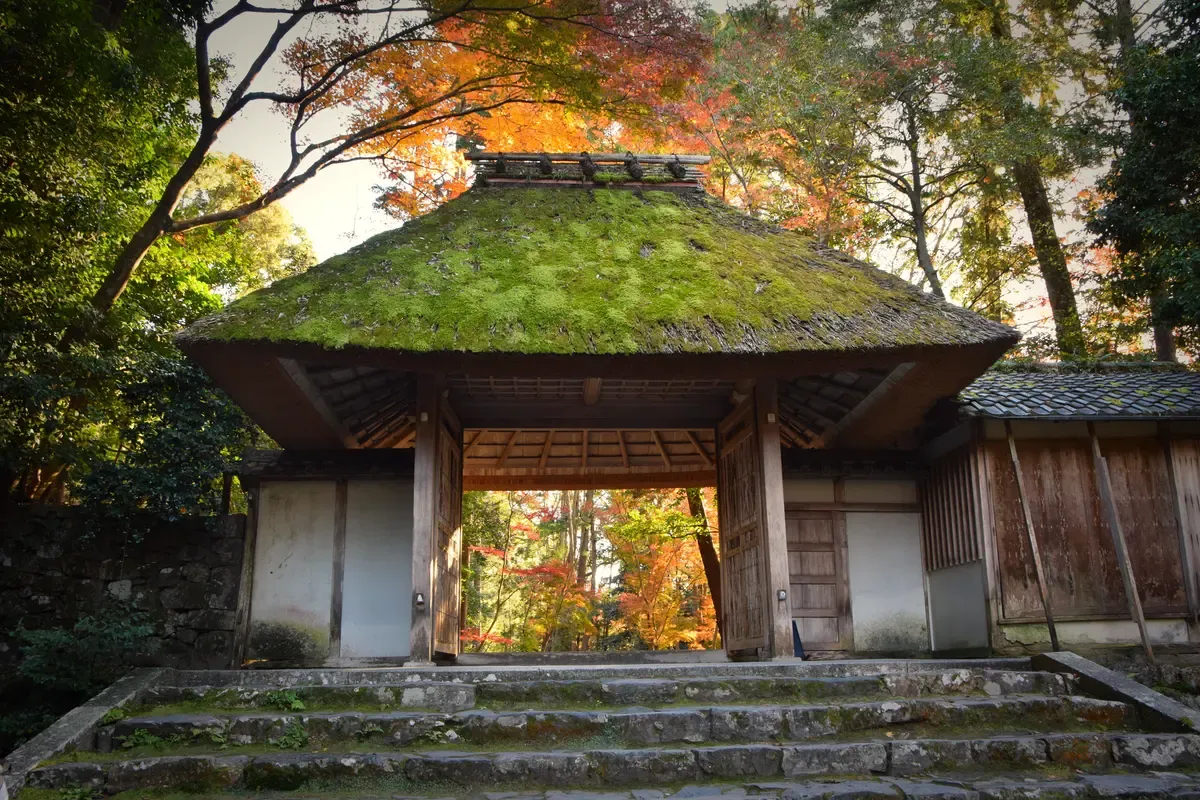
A moss-roofed gate at Honen-in surrounded by autumn leaves. Photo: Raita Futo from Tokyo, Japan, CC BY 2.0, via Wikimedia Commons
What to Bring and What to Leave
A day bag for a Kyoto day trip is light, but three things catch people out: cash, shoes and luggage.
Cash and Cards
Bring cash. Deer crackers in Nara Park cost around 200 yen, the Kasuga Taisha inner area costs 700 yen, and small temple counters such as Kurama-dera's 500 yen mountain fee are not places to argue with a card machine. Carry an IC card for the gates and a bank card for the station ATMs.
At Koyasan temple lodgings, useful if a day turns into two, most temples accept cash only.
Shoes and the Climb
Wear shoes you can walk in all day. The full Fushimi Inari mountain loop takes about 2 to 3 hours, and the Yotsutsuji viewpoint sits about 30 to 45 minutes up. The Himeji Castle tower has steep stairs and no elevator, and visitors carry their shoes inside, so slip-ons beat laces.
The Kibune to Kurama hike takes about one hour up a steep trail plus 30 minutes downhill to Kurama town. Sanzen-in in Ohara is a 10 minute uphill walk from the bus stop, and Itsukushima's Mount Misen summit is a further 30 minutes on a steep trail from the upper ropeway station.
Luggage and Lockers
Leave big bags at Kyoto Station rather than hauling them to Nara or Himeji. Coin lockers cost about 400, 500 and 700 yen for small, medium and large, and the largest locker area sits at the Hachijo exit. Oversized luggage can be left at Crosta Kyoto on the B1 floor.
For the summer, bring water and a hat, because August highs average about 33 degrees C in the basin. In the rainy season window, a compact umbrella earns its space. On winter mountain days, add a layer, since Enryaku-ji's outer areas open 30 minutes later from December to February and the hills run colder than the city.
If You Book a Tour
Booked day trips from Kyoto all start near the station, and almost none include hotel pickup. Knowing the meeting point system saves a stressed morning.
The Meeting Points
A handful of meeting points cover nearly every listing. The Kyoto Station Hachijo Entrance Square Sunken Garden is the start for the Katsuo-ji, Arashiyama and Kinkaku-ji day tour at $82 and the Amanohashidate, Ine Funaya and Miyama day tour from $86. Kyoto Avanti, a shopping complex about 3 minutes on foot from Kintetsu Kyoto Station outside the Hachijo exit, hosts two: the JTB desk on its B1F for the Nara afternoon tour with Todaiji and Kasuga Taisha at $100.40, and Tully's Coffee inside for the Nara and Uji matcha day tour at $126.24. The Nara Park, Osaka and Kobe full-day tour at $129 meets outside the Hotel Keihan Kyoto Grande, and the early morning Nara walking tour at $68.02 meets at the Kyoto Station Central Ticket Gate on the north side, where Kyoto Tower stands, not the Shinkansen Central Gate.
Arrive Early, and Read the Inclusions
Arrive 10 to 15 minutes before departure. Coaches leave on time, and the Hachijo sunken garden is 110 meters straight from the JR Tokai Hachijo East Exit. Hotel pickup appears on one listing only: the private Kyoto and Nara customized day tour at $510 for up to 6 people collects you at your hotel.
Free cancellation runs 24 hours ahead on most listings, but the H.I.S. Hiroshima day needs 7 days. Lunch is extra on most listings. Exceptions are the Hiroshima day with an okonomiyaki lunch in the price, at $114, and the matcha tour, where lunch comes only if you buy the lunch option.
Watch the options: the Amanohashidate listings charge for the cable car and Ine Bay cruise unless you pick the included-ticket package, the Hiroshima bullet train day at $119 includes train tickets only if that option is selected, and on the bus tours Tenryu-ji, Katsuo-ji and Kinkaku-ji entries are paid on site.
Tours and Trains Compared
A coach tour removes navigation work and bundles a guide, at the cost of fixed timing and holiday traffic, which one listing warns can delay the return by 2 to 5 hours. The train do-it-yourself day to Nara costs 720 yen each way, so the choice comes down to how much you value a guide and a fixed plan. The full comparison of day tours from Kyoto sits on the homepage.
Planning Tips
Five habits that make the day run, and four mistakes that break it.
Do
- Do match the station to the destination before you set out, because Demachiyanagi, not Kyoto Station, is the Eizan gateway for Kurama and Kibune.
- Do carry cash as well as an IC card, since temple counters such as Kasuga Taisha's 700 yen inner area and the 200 yen deer crackers are cash territory.
- Do check the official site for hours, because Himeji Castle's own page gives 9:00-17:00 with entry until 16:00 while other sites differ.
- Do reserve seats on the Hashidate and Kinosaki limited expresses, where reservations are mandatory.
- Do arrive at tour meeting points 10 to 15 minutes early, since coaches depart on schedule from the Hachijo sunken garden.
Don't
- Don't assume the Japan Rail Pass covers everything, because it excludes Kintetsu, the Eizan Railway and the Kyoto Tango Railway to Amanohashidate.
- Don't plan a ropeway day in typhoon season without a fallback, since Biwako Valley may suspend operations in severe weather.
- Don't start temple days late, because Himeji stops entry at 16:00 and Kofuku-ji at 16:45.
- Don't assume lunch is included on a tour, because most listings exclude it, and the Hiroshima day that does include it asks for 7 days notice on cancellation.
Planning a Day Trip from Kyoto: Questions
Which station do I use for a day trip from Kyoto to Nara?
Both work. Kyoto Station serves JR Nara in 45 minutes for 720 yen on the Miyakoji rapid, while the Kintetsu platforms near the Shinkansen Central Gate serve Kintetsu Nara in 35 minutes on the limited express for 1,280 yen, or 45 minutes by express for 760 yen. Kintetsu Nara Station is closer to the deer park. The full routes sit on the Kyoto to Nara train page.
Does the Japan Rail Pass work for day trips from Kyoto?
For JR days, yes. It covers the Nara Line to Nara and Uji, the Special Rapid to Osaka, Kobe and Himeji, and the Sanyo Line to Miyajimaguchi. It does not cover Kintetsu trains, the Eizan Railway to Kurama, or the Kyoto Tango Railway to Amanohashidate, which the JR Kansai WIDE Area Pass does reach.
Where do tours leave from in Kyoto?
Mostly from two spots on the south side of Kyoto Station: the Hachijo Entrance Square Sunken Garden for the bus tours, and Kyoto Avanti across the road for others, with one meeting at the Hotel Keihan Kyoto Grande and one at the north Central Ticket Gate. Details are in the tour logistics section.
When should I avoid travelling from Kyoto?
Golden Week, Obon and Silver Week fill the trains, and the foliage weeks around mid-November to early December plus the cherry blossom weeks of late March to early April do the same. Typhoon season peaks in August and September, when ropeways can close. The timing table above lists the windows.
Do I need to book train seats in advance from Kyoto?
Only for limited expresses. Seat reservations are mandatory on the Hashidate and Kinosaki limited expresses toward Amanohashidate and Kinosaki, and all Kintetsu limited express seats are reserved with a separate ticket. Ordinary JR rapid trains to Nara, Osaka, Kobe and Himeji need no reservation, just an IC card tap.
What does a booked day trip from Kyoto cost?
Listings on this site run from $55.10 for the Amanohashidate and Ine Funaya bus day trip to $510 for the private Kyoto and Nara day with hotel pickup for up to 6 people, with most group tours between $68 and $129. Lunch and temple entries are extra on most of them. Browse all day trips from Kyoto before choosing.